Redirected walking
Redefining virtual spaces through AR/VR innovation.
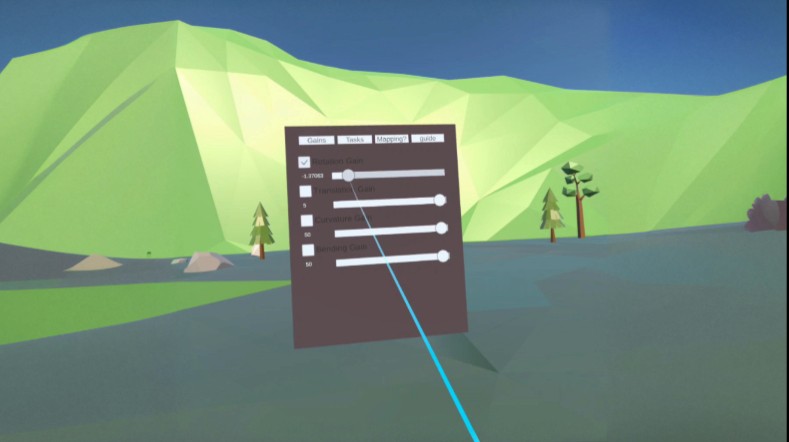

The Helsinki XR Center set out to push the boundaries of virtual reality by exploring how physical spaces can be seamlessly expanded into virtual worlds. This project aimed to uncover the limits of natural-feeling virtual environments within constrained physical spaces using advanced AR/VR technologies.
Timeline
From initial research to functional prototypes in 4 months, while balancing rigorous testing and fine-tuning across multiple simulations.
Background
Traditional systems struggle to provide immersive experiences without requiring large setups. To address this, the project explored techniques like dynamic camera movements and spatial manipulation to amplify the perception of space. The result is a system that expands virtual environments while maintaining natural, intuitive interactions, paving the way for next-generation AR/VR applications adaptable to real-world constraints.
This section outlines the methodical approach used during the project, encompassing research, planning, design, development, testing, and evaluation.
Research & Planning
Explored the potential of AR/VR to extend physical reality into virtual environments by analyzing existing technologies like ARCore and ARKit and user expectations. Defined project objectives, identified critical metrics such as curvature, movement, and gain parameters, and mapped out a clear development roadmap.
Design & Prototyping
Developed prototypes using Unity’s XR Interaction Toolkit to simulate virtual spaces and test amplification algorithms. Implemented custom shaders and physics simulations to evaluate curvature, movement, and gain effects. Leveraged Git for version control and Figma for collaboration on user interface designs,
Development & Implementation
Employed Unity’s C# scripting for algorithm implementation. Used a modular architecture to separate amplification logic, ensuring flexibility and scalability. Camera movement amplification algorithms were designed using mathematical transformations to simulate curvature and bending gain. Integrated OpenXR for cross-platform compatibility with major AR/VR devices.
Testing & Optimization
Conducted performance testing using Unity Profiler for real-time debugging. Evaluated user experiences through A/B testing on different VR devices. Optimized rendering pipelines with dynamic resolution scaling and occlusion culling to maintain high frame rates and low latency.
The resulting AR/VR software utilizes advanced algorithms and robust frameworks to extend physical spaces into immersive virtual environments seamlessly.
Technological Backbone
Built with Unity and Unreal Engine, leveraging ARCore and ARKit for camera tracking and spatial analysis.
Customizable Parameters
Adjustable curvature and movement amplification parameters, supported by a modular architecture for flexibility.
Cross-Device Compatibility
Integrated OpenXR tailored for Meta Quest 3, however, ensuring seamless functionality across major AR/VR headsets.
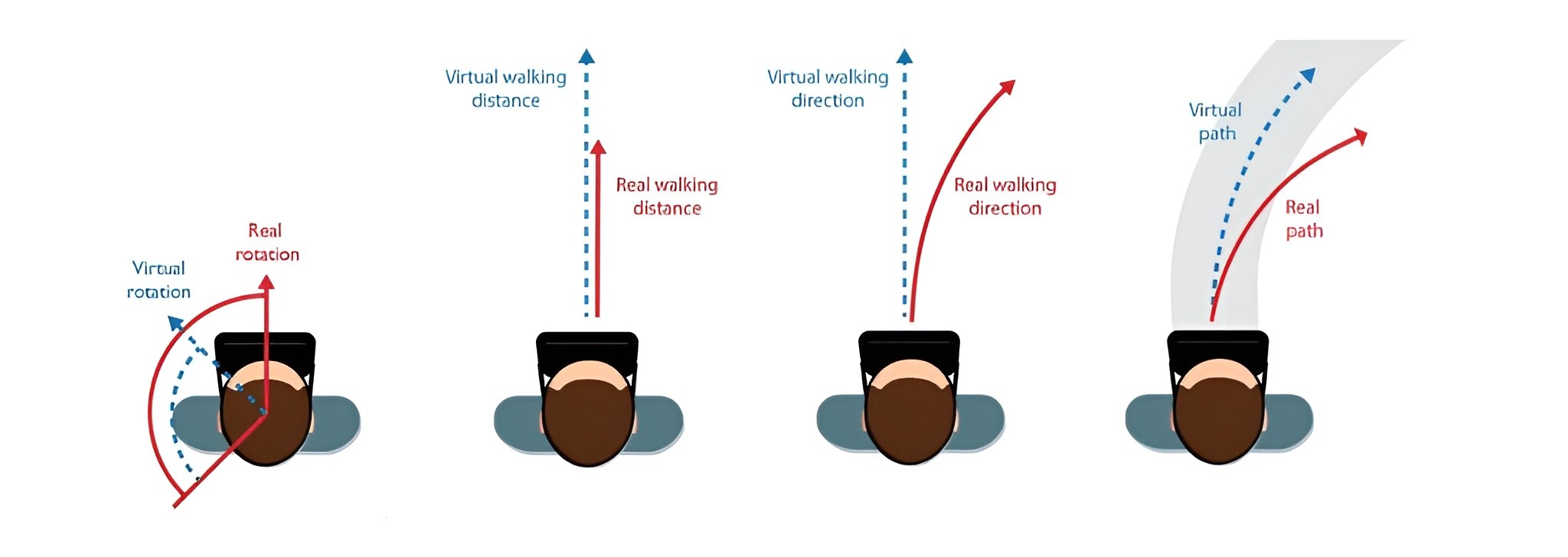
The image below illustrates the different kinds of gains implemented in our AR/VR solution. It showcases how various amplification parameters, such as curvature and movement gain, are applied to simulate the expansion of physical spaces into virtual environments. Each type of gain is visually represented, highlighting the effect it has on user perception and navigation within the virtual world. These gains allow for dynamic adjustments based on user input and environmental factors, ensuring that the virtual experience remains natural and intuitive despite the constraints of physical space.
The project demonstrated the potential of AR/VR to create expansive virtual environments with cutting-edge technology, delivering key outcomes:
Technical Insights
Provided in-depth data on optimizing AR/VR frameworks for spatial expansion.
Positive User Feedback
Users praised the natural feel of the virtual environments, supported by advanced amplification algorithms.
Scalability
The modular architecture ensures the software can adapt to evolving AR/VR technologies and diverse physical constraints, and is easily able to integrate within different applications.
This project was a bold step for our team, as we decided to step out of our comfort zone and explore entirely new technologies. Instead of relying on familiar tools, we took on the challenge of working with XR and VR, setting everything up from scratch and learning together as a team. This collaborative effort not only pushed our boundaries but also fostered an environment of shared growth and innovation.
Through this experience, I gained valuable hard skills in 3D modeling, immersive design principles, and developing VR applications. Additionally, I worked extensively with tools like Unity and Unreal Engine, learning to create interactive virtual environments and optimize performance for immersive experiences.
The project was also a testament to excellent teamwork, where each member leveraged their strengths to build something that has the potential to transform how VR is utilized in the future. It was a dynamic blend of learning, problem-solving, and creativity that expanded both my technical expertise and my ability to collaborate effectively in a cutting-edge domain.